
WTI and Brent Oil Prices Today: February 24, 2026
Introduction
The oil market remains a cornerstone of global economic stability, industrial activity, and consumer pricing. On February 24, 2026, fluctuations in West Texas Intermediate (WTI) and Brent crude oil prices continue to draw close attention from investors, businesses, and policymakers. These critical benchmarks reveal insights into supply-demand dynamics and market sentiment amid evolving geopolitical tensions and breakthroughs in energy technology. This article delivers an in-depth update on today’s oil prices, uncovers the drivers behind recent price movements, and forecasts key trends shaping the market’s future.
Current Prices Overview
WTI Crude Oil Price
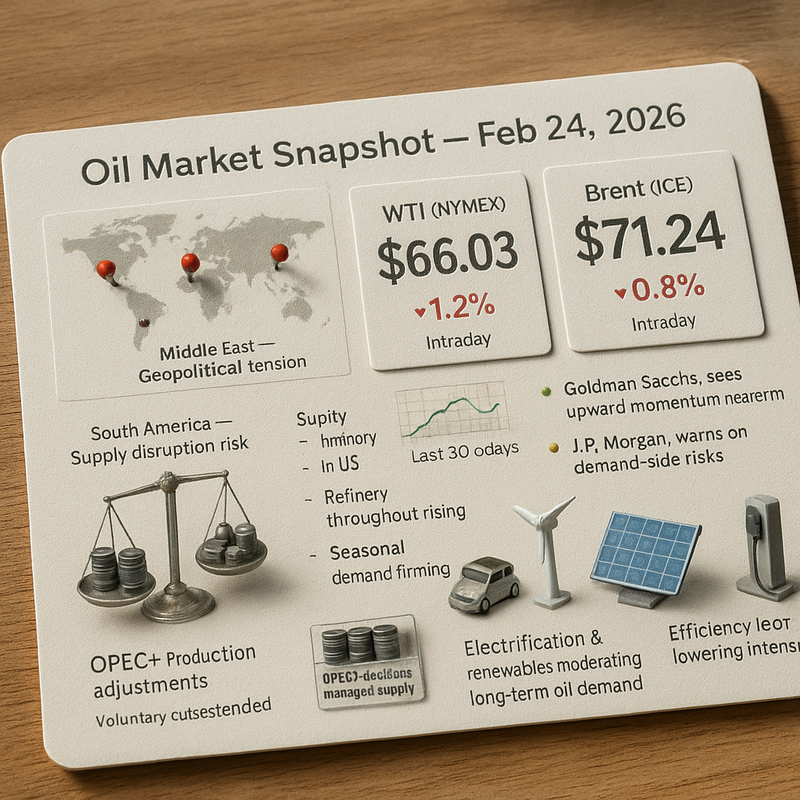
As of today, WTI crude oil is trading at approximately $66.03 per barrel on the New York Mercantile Exchange (NYMEX). This marks a rise of $0.40 or 0.61% from the previous session, reflecting tightening supply conditions and shifting demand projections in major oil-consuming regions.
Brent Crude Oil Price
Brent crude, the global pricing benchmark, stands near $71.24 per barrel—up by $0.17 or 0.24% compared to its last close. This modest increase signals cautious optimism around the future balance of oil supply and demand.
Comparative Snapshot
| Oil Type | Current Price | Change ($) | Change (%) |
|---|---|---|---|
| WTI | $66.03 | +$0.40 | +0.61% |
| Brent | $71.24 | +$0.17 | +0.24% |
WTI shows slightly stronger short-term momentum versus Brent, highlighting differences in regional market dynamics.
Understanding the Price Dynamics
Key Factors Influencing Oil Prices
- Geopolitical Tensions: Ongoing instability in oil-producing regions, particularly in the Middle East and South America, continues to disrupt supply forecasts and fuels price volatility.
- Supply and Demand Balance: Robust global economic growth projections drive higher fuel consumption expectations, tightening supply chains and pushing prices upward.
- Inventory Reports: Recent U.S. Energy Information Administration (EIA) data revealed a drawdown of 2.1 million barrels in U.S. crude inventories, signaling strong demand relative to supply.
- OPEC+ Production Policies: Coordinated production strategies among OPEC and allied producers remain critical for maintaining market equilibrium.
- Economic Indicators: GDP growth, manufacturing output, and employment figures play a pivotal role in forecasting oil demand.
- Advances in Alternative Energy: Growing investments in renewables and decarbonization policies introduce uncertainty for long-term oil demand.
Current Market Context
Geopolitical Developments
Heightened geopolitical risks—such as tensions in the South China Sea and political instability in Venezuela and Nigeria—continue to exert upward pressure on prices, as markets brace for potential supply disruptions.
Post-Pandemic Demand Recovery
The global demand recovery from the COVID-19 pandemic is gaining momentum, especially across Asia and Europe, where renewed industrial and transportation activities reinforce bullish oil consumption forecasts.
Inventory Insights
The recent drawdown in U.S. crude stocks underscores tighter supply conditions, reflecting heightened domestic demand, increased exports, or restrained production growth—all supporting upward pressure on prices.
Future Projections for Oil Prices
Short-Term Outlook
Most analysts expect continued price gains in the near term, assuming geopolitical risks remain contained and OPEC+ sustains disciplined production cuts. The tug-of-war between recovering demand and managed supply will be the decisive market force.
Long-Term Trends to Watch
- Rising Production Capacity: Elevated oil prices could spur U.S. shale producers to ramp up output, potentially easing supply constraints.
- Energy Transition Impact: Global shifts towards sustainability and cleaner energy policies will reshape oil demand trajectories, presenting both challenges and opportunities.
- Technological Innovation: Progress in extraction technologies and efficiency improvements will affect future supply availability and cost dynamics.
Expert Insights
- Goldman Sachs predicts that steady demand recovery could drive prices above $80 per barrel later in 2026, indicating sustained market strength.
- Conversely, J.P. Morgan warns of potential volatility risks amid economic uncertainties and highlights the importance of OPEC+ responsiveness to avoid sharp price swings.
Conclusion
Today’s WTI and Brent crude prices reflect a delicate balance of geopolitical challenges, supply-demand fundamentals, and broader economic signals. WTI stands at $66.03 per barrel, while Brent is at $71.24, both edging higher amid firm demand prospects and supply concerns.
Key Takeaways
- Moderate price increases underscore recovering global demand combined with ongoing geopolitical risks.
- Inventory levels and OPEC+ production policies remain key short-term price determinants.
- Long-term market trends will be shaped by production economics, technological advances, and the energy transition.
Strategic Considerations
For investors, business leaders, and policymakers, staying informed with up-to-date oil price data, geopolitical developments, and industry reports—such as those from the EIA and OPEC—is crucial. Diversifying energy portfolios and incorporating scenario planning will help navigate the volatility of oil prices and capitalize on emerging opportunities.
By understanding today’s market landscape, stakeholders can better anticipate challenges and seize potential growth avenues in the evolving global energy sector.
